|
Nave & Aisles |

Alan of Walsingham
large slab with
almost obliterated brass indent
|

Dr Hodge-Mill (1853) copper effigy
(electro-plated) on tomb chest of alabaster and
mosaic; designed by
Sir G G Scott,
executed by Philip. He taught in India
and was later Professor of Hebrew at Cambridge;
the figures at hyyyyyis feet represent an Indian and
an English student.
|

Bishop Woodford
(1885) by
Bosley. He
founded Ely Theological College
|
|
|
The
Cloisters |
|

|

|
|
|
W. Pickering and R
Edgar (1845) killed in accident on
Norwich to Ely railway. Slab with poem 'The
Spiritual Railway'. In the remains of the
cloister against nave wall.
|
Humphrey Smith (1743)
bust in oval medallion on which rests putto,
grey obelisk behind; designed by John
Sanderson carved by Charles Stanle.
Actually in south porch, leading from remains of
cloister.
|
|
|
|
North
Chancel Aisle
|
|

|

|

|

|

|
 |
|

|

|
|
Dean Caesar (1636)
painted
alabaster
|
Bishop Fleetwood (1723)
Inscription; signed by E Stanton & Co Horsnaile
|
Top:
Bishop Nigellus (?) (1169) Tounai marble Coffin
shaped slap carved in very low relief which was found
below floor of St Mary's church in 1829. The bishop is
shown as a naked soul in a napkin held by a larger
angel. Above the head is incised: St. Michael oret
P[ro] Me.and a carving of the church he founded.
Bottom: Unknown
Bishop headless effigy in higher relief with a goose at
feet. This effigy has been attributed with little
evidence to Hugh of Lincoln who is said to have owned a
pet goose!
|
Canon Fleetwood (1737)
by P Scheemakers
|
Above Left Top: Bishop Redman (1506)
effigy on paneled
tomb chest with canopy and above right:
the canopy from the choir.h
Above Left Bottom: Bishop Hugh of
Northwold (1254) The three figures at the foot
show the story of St Edmund
|
 |
 |

Above:
Bishop Laney (1675) black and
white marble. |


|
 |
George Basevi (1845)
Brass to the architect who designed the
FitzWilliam Museum in Cambridge. He is shown with the
tools of his profession. He fell to his death while
inspecting the West Tower of the Cathedral. |
|
Above left: St Etheldreda's Shrine remains
of capitals below a superstructure which is said to be
either a 14th century new casing of the shrine or
perhaps the canopy part of Bishop's Hotham's monument .
The ground stage has blank ogee arches.
Above right: Bishop Patrick (1707)
. By E Stanton.
|
Right: Bishop Kilkenny (
1257) Purbeck marble effigy, flanked by columns
carrying trefoil canopy, on tomb shaped slab; angels in
the spandrels. Higher relief again
|
|
|

|

|

|
East End |
|

|

|
|
Bishop Alcock's Chantry
(1501) This was begun as early as 1488. The
effigy is high up on the north wall on the widow ledge
so difficult to see although looks in poor condition;
the tomb chest is below being without an effigy. The
chapel has fan vaulting and wrought iron gates with the
original lock.
|
Cardinal de Luxemboug (1443)
effigy on tomb chest with quatrefoils enclosing shields
and with canopy
|
Bishop West's Chantry
(1534) Again this was made early - in 1525-33.
A less elaborate exterior but again with wrought iron
gates which themselves are actually more elaborate than
those of Bishop Alcock's chapel. Bishop West opposed
King Henry VIII's divorce from Kathryn of Aragon and
hence fell from favour. Inside are recorded the
reburial in the south wall of several chests containing
bones of the following Anglo-Saxon Bishops - Wulstan
(York), Osmund (Swedish), Alwin (Elmham), Aelfgar
(Elmham), Ednorth (Dorchester - on - Thames) and
Athelstan (Elmham) and Brithnoth, Earl of Essex.
|
|
Bishop Sparke (1836)
brass on the floor of Bishop West's chantry. Similar
brass but covered so not identified. (not shown)
|
|
South Chancel Aisle |
 |
 |
 |
 |
 |
 |
 |
 |
Left Top: Bishop
Hotham (1337) tomb chest with arcades which
were once filled with statuettes, only one of which
survives. The effigy - now lost - was of alabaster. The
former canopy may now be part of St Ethelreda's shrine
(see above)
Left Bottom: Canon
Selwyn
(1875) - of Selwyn College and Selwyn Divinity School in
Cambridge. Recumbent effigy
Centre: John Tiptoff, Earl of
Worcester (executed 1470), and Wives
Effigies
on tomb chest with quatrefoils with shields with canopy
Right : Bishop
Peter Gunning (1684) Semi-relining effigy, head
propped up by arm. Rests on tomb chest which has no
backing. His ledger stone is shown below - |
Left Top: Bishop
Barnett (1374) plain tomb chest with two tiers
of quatrefoils, brass lost from fragmented top.
Left Bottom: Bishop
Goodrich (1554) brass, the surround is only
preserved as an indent. He followed Bishop West and
assisted in Henry VIII's divorce and decreed, in 1541,
that images, relics, shrines and table monuments were to
be 'totally demolished and obliterated'
Centre: Dean Tyndall (1614)
brass
Right:
Bishop Heton (1609)
alabaster; recumbent effigy in front of two black
columns |
 |
 |
 |
 |
 |
 |
 |
 |
Left:
Bishop William de Luda (1299)
Canopy only - although very fine - but no tomb chest.
You can 'walk through' the canopy from choir to aisle.
On the floor under the canopy is a brass matrix of a
bishop. Through the arch can be seen the monument
of Bishop Heton
Centre Top: Sir Robert
Steward (1570) semi-reclining effigy in armour,
propping head up with his arm. Tuscan columns carrying a
pediment Bogus heraldry
Centre Bottom: Black ledger stone
of Bishop Peter Gunning
Right: Sir Mark Steward (1603)
six poster with top obelisks; recumbent effigy.Brother
of Robert above. Bogus heraldry and pedigree proclaiming
descent from the royal house of Stuart |
Left:
Bishop Greene (1738)
standing wall monument with two columns flanking urn
Centre Top:
Bishop Butts
(1748) portrait bust on monument of coloured
marbles. To the left are the low relief profiles of
Canon Michael Glazebrook DD and his wife,
Ethel (both 1926); to the right is the tablet to
Prebendary James Bentham (1771) who wrote the
History of Ely
Centre Bottom:
Bishop Allen
(1814) semi-reclining white marble effigy by
I Termouth
Right: Bishop Moore
(1714) two putti on either side of inscription
plate with urn on top |
|
Choir |
|

|

|
|
Prior Crauden (1341)
original stone work with renewed brass
|
Bishop Hotham
similar but probably nineteenth century
|
|
|
North Porch |
|

|

|
|
Several tablets have been
moved from the transepts to this porch. There
are also a few minor tablets in the church and
several stones and brass matrices, which will be
catalogued in due course.
|
|
top of page
|
 |
 |
 |
 |
| Edward Wood (1599) &
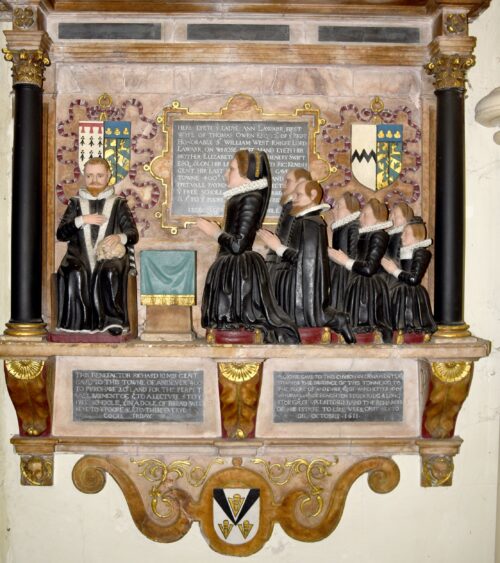
Elizabeth Chichele Separate to the main part of the
monument is a frieze on corbels and achievement. No
inscription but arms of Chichele and Clopton; Edwards's
mother, Elizabeth, was the daughter and heiress of Edward
Clopton |
 |
Isleham - St Andrew |
 |
| The church is unlocked during
daylight hours. You may park free in the village
TL 643 743 |
| Nave |
 |
|
Chancel |
 |
 |
Nave
Above: Ethelreda Moody (1733)
(?) and three children buried in the same vault:
Robert, Ethelreda and M____
Right: Ada Jane Watson ( 1856)
female figure reading book on plinth and under canopy;
inscription below. South wall of south aisle.
Chancel
Far Right: Thomas Peyton (1484)
and Two Wives He in armour: brasses on tomb chest;
shields from front gone. Behind is recess with paneling
under arch; heraldry. The brasses are illustrated in
Pevsner. |
 |
 |
 |
North Chapel |
 |
 |
Left: Barbarie Themilthorpe (1619)
Mounted high on
east wall. She lies on her side with her hand under her
cheek on large pillows. Worn inscription . Painted shield
above. She died aged seven
Centre: Roger Peachy (1683) He was vicar of
the parish for 37 years. Inscription on slate panel with
surround. Skull below, arms above.
Right: William Bernard. c. 1300. knight in
recess under arch in north wall. Mutilated. Legs once
crossed |
 |
South Chapel |
 |
 |
Left: possible William
Barnard. Late 14th century. Straight legs.
Under a low arch below window in south wall. Difficult to
access as now blocked by two later big standing monuments.
(v.i)
Above: possibly Sir John Bernard.
Early 15th century. Straight legs. Note bare head and beard.
Not in situe. |
 |
 |
 |
 |
Above:
Sir John
Bernard (1451) & Ellen (?)
Brasses under canopy on low tomb chest. The
shields on the slab and the sides have gone -
except one of lead on the knight's left.
The Latin inscription is now placed
above the canopy and records two wives: Ellen
Swynerton and Elizabeth Sakevyle.
Right: Sir Robert Peyton (1550)
Far Right:
Rychard
Peyton (1574) & Mary
Brasses under canopy . Palimpsest.
On floor:
roll the carpet back! |
 |
 |
 |
 |
Left and above
left: Sir Robert Peyton
(1590) & Wife. Whole monument and detail of
effigies.
Right and above right:
Sir John Peyton (1616) &Wife.
These two
monuments obscure the knight in the recess in the south
wall |
top of page
|

|
Landwade - St Nicholas |

|
|
The church is situated on a private
estate and is locked. If wishing to visit please write
to Mr Simon Gibson of the nearby Landwade Hall for the
key, stating your interest. You may park on the site.
|
| Chancel |

|
 |
 |
 |
 |
Above left:
Table tomb in centre of chancel
which can just about be made out in the photograph of
the interior. The sides are plain but the top slab has
faded indents of brasses which can just be made out in
the second photograph; there is a central cross with two
scrolls on either sides, presumably words from figures
kneeling at the base of the cross
Above right:
Grave slab on chancel floor; there is
no inscription, heraldry etc but a Calvary Cross carved
in relief. |
Above left:
Table tomb: the shields again may
have had brasses attached. The top slab is badly damaged
but originally held brasses: there are only remains of
indents of two small kneeling figures at the foot of the
slab.
Above right:
Table tomb: the shields again may
have had brasses attached. The top slab is badly damaged
but originally held brasses: there are only remains of
indents of two small kneeling figures at the foot of the
slab.
Far Right: Table tomb; the back has
indents for several brasses: at least three kneeling
figures with scrolls. There is nothing on the top slab.
The shields along the side appears once to have had
brasses attached. |
|
Also on
chancel wall:
2 simple tablets:
Black with white lettering - facing each other across
chancel: George C Gibson OBE of
Landwade Hall, Exning who died in 1989
at 93 and was buried in Cathays Cemetery, Cardiff; his
wife Madeleine who died in 1993
aged 96.
Grey, red lettering:
William James Tatem, 1st Baron Glandy of St
Fagans. Killed by enemy action in 1942
aged 75.
Wall Brasses:
1.William Cotton,
Latin inscription, small brass
2.Ambrose Alexander
Cotton, large brass in stone surround,
heraldry.
3.Charles Edward Baird,
Cpt Seaforth Highlanders 78th Rosshire Buffs. Son of
Brig-Gen Baird. Born 1894, killed in action near
Beaumont Hamel, France. Military badge and medal.
4.Alexander Cotton
of Landwade, Lt RN, son of Rev A A Cotton, ob
1860. Also John Hynde Cotton,
Lt 12th Lancers, son of above, killed by fall from horse
at Secunderabad in 1857 aged 22. Also
Harriet, daughter of Alexander who died
at 16 in 1850 and was buried in
Gronville, Jersey.
5.Henrietta, wife
of Alexander, died 1899 aged 83. Buried
in Quendon.
|
|
North Transept |
|

|

|

|
|

|
|
Six-poster with two recumbent
effigies. 'Here lieth intombed the bodie of Sir
John Cotton Knighte Sonne of Sir Roberte Cotton
Knighte. And also the bodie of Dame Isabell,
Wife of the saide Sir John and daughter of Sir William
Spencer, Knighte.' He died in 1593 at
81, she in 1578 at 63. They had 8 sons
and 5 daughters. 5 sons and 2 daughters 'died in their
nonage'
|
Sir
John Hynde Cotton Bart. (1752 aged 66) Son of
the Sir John who died in 1712 (see below). Married 1.
Letitia by whom he had 1 son John Hynde
and 1 daughter Mary; 2. Not named but no issue.
Also commemorates John
Hynde above (1793) He was
however buried at Madingley 'the present residence of
the family'
|
|
South Transept |
 |
 |
 |
 |
|
Sir John Cotton, Knight (1620 aged
77)- son of John Cotton. He married: 1. Elizabeth, 2.
Elizabeth, by whom and had no issue, and 3. Anne, by
whom he had 2 sons - James and John - and 1 daughter -
Katherine; only John survived him. He reclines; she is
recumbent and holds a book. Heraldry and inscription
|
Sir John Cotton Bt.
(1689 aged 74) -
son of Sir John Cotton left . He married 1. Jane Hind by
whom he had 2 sons and 2 daughters: John, Thomas, Jane
and Anne. John and Jane survived him. Inscription and
heraldry. Reclining effigy
|

Above:
Unassigned tomb chest. The back plate has
several indents for brasses with their fixing holes
well visible; possibly two kneeling figures with
scrolls, shield and inscription. Nothing on top slab.
|

Above:
Sir John Cotton (1712 aged
66) - son of the Sir John who died in 1689) &
Elizabeth (1714 aged 57) They had 1 son
- John Hynde - and 7 daughters - Jane, Anne, Catherine,
Elizabeth, Frances, Dorothy and Agnes. 'Sr John was
Recorder of Cambridge for wch. he serv'd many years in
Parliament'. By Thomas Adey
|
|
|

|
Wimple - St Andrew |

|
|

|
|
Sir Thomas
Chicheley (1616) & Family (above left illustraton -
recumbent effigy on left)
Catherine (1759), Wife of
Hon. Charles Yorke (above left illustration - east of above
monument) Designed by James Stuart; executed by
Scheemakers
Philip, 1st Earl of Hardwicke
(1764) (above left illustration- large monument
background right) The Lord Chancellor. Designed by James
Stuart; executed by Scheemakers
Hon. Charles Yorke (1770)
Oblelisk with portrait medallion and putti about an urn. By
Scheemakers
Elizabeth (1766), Wife of
Hon. John Yorke unsigned
Philip, 2nd Earl of Hardwicke (1790) Woman bend
over an urn. By Banks
Rt. Hon. Joseph Yorke (1792) by John
Bacon (1798)
Hon. John Yorke (1801) (above - far right)
By Sir Richard Westmacott
Mrs Charles Yorke (1801) By Flaxman
Philip, 3rd Earl Hardwicke (1834) (above -
centre illustration and above left, centre monument) by
Westmacott Jnr (1844)
Joseph Sydney Yorke (1831) Mourning woman
by side of a ship
|
|