|
Some Notes on the Religious Foundations in Winchester
Around 648 Cynegils, King of Wessex, built a church in
Winchester which came to be known as The Old Minster. The actual
see was originally founded at Dorchester in Oxfordshire in 635
but was moved to Winchester in 679 when the church became a
Cathedral Church. The Old Minster acted as a burial place for
the Kings of Wessex and Bishops of Winchester. This church was
enlarged by Bishop Athelwold, being rededicated in 980 and again
in 993.
In 1079 Walkelin, the first Norman Bishop of Winchester, began a
new church which was ready for worship in 1093. The Old Minster
was abandoned and demolished, although the bones of the various
kings and bishops were translated to this new church, which
survives in part as the Winchester Cathedral of today. The Old
Minster was situated north of the nave of the present church and
was excavated between 1961 and 1966 by the archaeologist Martin
Biddle; these excavations are described in The Old Minster;
Excavations near Winchester Cathedral 1961 by Martin Biddle
(Winchester 1970). Today Winchester is a Cathedral of the New
Foundation.
King Alfred and his Queen founded two monastic churches in
Winchester. Alfred's foundation -
The New Minster - was close to the Old Minster, so close,
in fact, that singing from the one church is said to have
disturbed those in the other and, according to William of
Malmesbury, effected a rivalry which led to 'frequent injuries
on either side'! Alfred's Queen founded the Abbey of St Mary,
usually known as The Nuns' Minster. These two churches were
completed by Alfred's son, King Edward the Elder and the
Anglo-Saxon Chronicle records that the New Minster was
consecrated in 903. William of Malmesbury writes that King
Alfred was firstly buried in the Old Minster because the New
Minster was not yet ready at the time of his death. When the New
Minster was completed, Edward removed his father's body for
reburial in the new church. Alfred's Queen, although she died
on the Nuns' Minster, of which she became abbess, was also
buried there. Edward himself was also buried in the New Minster
as was King Edwy at a later time.
And there they remained until William Giffard removed the New
Minster to Hyde - a suburb of Winchester - in 1110 (time of
Henry I). The bodies of Alfred, his Queen and Edward the Elder
were translated to Hyde, being taken in procession by the monks
to their new home - now know as
Hyde Abbey. The New Minster itself was demolished. At
Hyde Abbey they rested in peace in until the Dissolution of the
Monastries when the abbey fell into lay hands, the church was
demolished and the graves lost. The possible sites of the graves
were found in recent excavations but the contents and any
monuments have been lost. Click here
for a fairly light hearted investigation of the whole story
|
|
Lady Chapel |
South-East (Bishop Langdon's) Chapel |
|

|
This is a modern stone to
Bishop White (1560).
A coffin was found in this position which was assumed to be his
. He was headmaster of Winchester College, where he prepared a
memorial brass in the chapel, and later Bishop of Winchester
under Mary I. He fell into disfavour under Elizabeth I and was
deprived of his see in 1559, six months before his death
|
|
Bishop Langton (1500)
The Purbeck Marble tomb chest fills the chapel. The lid has a
brass indent. Arms carved on the chest. He was elected
Archbishop of Canterbury but died of the plague a few days
later.
|
|
North-East (Guardian's
Angels') Chapel |


Richard Weston, Lord Portland (1634) A large
monuments with a bronze effigy by Le Sueur. A minister
of Charles I who eventually became Lord High Treasurer of
England - among many other posts - and a most unpopular man:
The prime agent of iniquity as he was called in the House of
Commons by John Eliot |

Bishop Peter
Mews (1706) Fought at Naseby, where he was taken
prisoner. After the Execution of Charles I, retired to Holland
where he acted as Royalist agent. As a reward was awarded many
ecclesiastical preferments. Fought at Sedgemore for James II
where he was wounded and afterwards wore a black patch over his
cheek to hide the scar. Buried in the Earl of Portland's vault.
He is said to have neglected his diocese |

Arnold de Gaveston (early 14th C)
This is the front only, showing shields with arms, of a Purbeck
marble tomb chest. The corresponding effigy is in the retrochoir
(qv) |
|
Retro-Choir: Nave |
|

|
Saint Swithun's 'Shrine' The acutal shrine
was destroyed at the Dissolution. This structure, over a
inscription on the floor, is by Brian Thomas & Wilfred
Carpenter Turner 1962
|

|
|

|

|

|
|
Bishop Waynflete (1486) Chantry Chapel &
Effigy. The effigy was repainted in 1932. Arms but inscription
lost. He was the first provost of Eton, founder of Magdelene
College, Oxford and chanceller under Henry VI
|
Above:
Bishop Charles Richard Sumner (1874)
cenotaph by Henry Weekes 1876
Below Left:
Prior William de Basyng (1295)
The slab is carved with a foliated cross and a mitre: a mitred
prior is unusual but the privilage was conferred by Pope
Innocent IV in 1254. Inscription around three sides of the edge
of the lid. See below.
Below
Right:
Bishop Godfrey de Lucy
(1204) Plain Purbeck slab but with matrices of sockets
to hold candles. Son of Richard, Chief Justiciar of Henry II
|
Cardinal Beaufort (1477) Chantry Chapel and
Effigy. Unlike Bp Waynflete's this chapel is open. The rather
crude effigy is 17th century work, possibly being a copy of that
destroyed in 1642 by William Waller's army when the cathedral
was ransacked. Arms but brass inscription lost. Son of John of
Gaunt, half-bother to Henry IV; weathy and more of a statesman
and soldier than an ecclesiastic. Persecuted the Lollards and
took part in the trial of Joan of Arc whose image now looks down
on him!
|
|

|
Other Monuments in this Site
1. large slab with brass matrix of an ecclesiastic, on floor
west of St Swithun's Shrine
|

|
|
Inscription on the
William de Basyng Tomb:
HIC JACET WILLELMUS DE BASYNGE QVANDAM PRIOR ISTIVS ECCLESIE
CVJVS ANIME PROPICIETVR DEVS: ET QVI ANIMA EJVS ORAVERIT III
ANNOS C ET XLV DIES INDULGENCIÆ PERCIPIET
(Here lies William de Basinge, formerly Prior of this church, on
whose soul may God have mercy: and whosoever shall pray for his
soul shall obtain an indulgence of three years, one hundred and
forty-five days)
|
|
Note
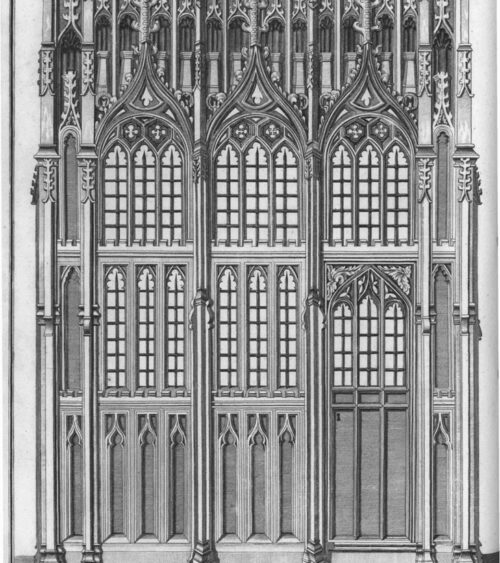
The Romanesque apse was demolished in the early 14th century and
the present straight screen constucted, the entrance to the Holy
Hole, under a platform behind the screen, forming a central and
unusual feature. Along the front of the screen is cut an
inscription:
The bodies of saints lie here buried in peace,
From whose merits many miracles shine forth.
A row of canopied niches, which orginally contained statues
removed at the Reformation, can be seen in this screen. Below
these niches are cut a series of names:
Kinegilsus Rex; Sanctus Birinus Episcopus; Kinewaldus Rex;
Egbertus Rex, Adulphus Rex; Eluredus Rex, filius eius; Edwardus
Rex Senior; Adthelstantus Rex, filius eius; Sancta Maria;
Dominus Iesus; Edredus Rex; Edgarus Rex; Emma Regina; Alwinus
Episcopus; Ethelredus Rex; Sanctus Edwardus Rex, filius eius;
Cnutus Rex; Hardecnutus Rex, filius eius.
It is said that these statuettes were probably intended to
commemorate the kings and bishops whose bones originally lay in
chests on the platform above but are now in the mortuary chests.
However it includes some who were certainly not buried at
Winchester and well as Jesus and the Virgin Mary. It thus may be
intended as a display statues of preconquest kings and others
not at all related to burials
|
|
|

Plan of Floor Slabs in South Aisle of Retrochoir
(not to scale - west is at the top)
Those not shown are as follows:
14. badly defaced or removed stone; possibly
Thomas Higgons
18.
Henry Surtees Altham (1965)
'teacher, author, cricketer, soldier' & his wife Alison (1970) |
|

17. Lady Elizabeth Shirley (1740) |

16. Frances Cecil (née Brydges), Dowager Countess of Exeter
(1663) |
|

13. Elizabeth, Countess of Essex (1656) She
married 1. Robert Devereux , Earl of Essex, the Parliamentary
commander in the first part of the Civil War and 2. Thomas
Higgons |

9. Prebendary Dr Baptista Levinz (1693) very large
ledger stone, now partly buried under radiator. He was bishop of
the Isle of Man. |
|
 |
 |
 |
14. Henry, Lord Pawlett (1672)
10. his wife Francisca (1682)
11. & son Essex (1682) |
|

12 Alexander Alchorne 1705 |

5. James Touchet, Baron Audley, 5th Earl of Castlehaven
(1700) |

1.
William Fulham (1699) infant son of Prependary
Dr George Fulham and Catherine, who had died in childbirth. |
|

Sir John Clobery MP (1687) Alabaster by
Sir
William Wilson. His stone is lost but those of his
children remain and are listed in this section. |
|
|
|
|

4. William Holden Hutton (1930)
|

3. Stone with matrix of ecclesiastical brass
|

2. Elizabeth Briscoe (1680)
|
|

William Walker (1918) The famous Diver of Winchester
Cathedral. The bronze on the left has been in the Cathedral for
about 25 years; that on the right was recently donated by a
visitor as a more accurate portrait taken from his photographs. |
| Retro-Choir: North Aisle |
|

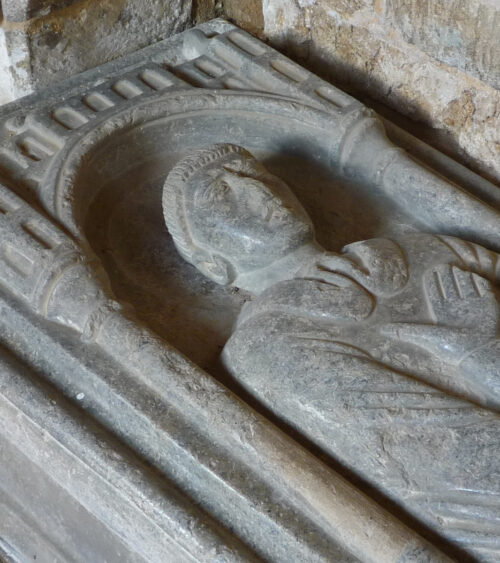
Torso of bishop or prior 13th century
|

|

|
|

|
|
There are several ledger stones and flat stones
in this part of the cathedral but many are worn or
damaged to varying extents rendering them totally or
partially illegible. The numbers refer to the floor plan
which I will provide after my next visit to the
cathedral.
|
|
1. Nic Alexander 1635 Flat stone
2. Rob Alexander 16__ Flat Stone
3. Susannah Taylor 1669 Age 4 Flat Stone
6. Illegible - 'Joannis'
9. Possibly Francis Alexander 1663
10. Illegible - 'Doro__Joynter--'
12. Illegible - 'Alexander'
13 Illegible
16. Illegible - '..age 16..'
A Obliterated
B Obliterated
19. Illegible - '1636'
21. Possibly Robert Mason
22. Possibly Catherine Mason
23. Illegible
24. Son of Henry Perin 1694/5
26. Elizabeth Kercher 1637 Wife of Canon Kercher
27. Illegible
28. Sara Tichborne 1616 Age 6 week Flat Stone
|
4.
Dr Arthur Taylor 1647
Physician
|

5. Edward Dennis 1667 |
|

7.Susannah Coker 1714
wife of Dr Wm Coker |
|

8.Dr William Coker 1704
Physician |
|
|

11. Frances Preston 1689 |
|

Above: 14 Susannah (1689) & William (1686)
Coker
Right:
15. Francis (1683) & Claus
(1686) Coker
These four infants were the children of Dr
Coker |
|
|

17. William Symonds 1606
Twice mayor of and benefactor to Winchester |
|

18. Prebendary Christopher Perin (or Peryn) 1612
Note that the Latin inscription has been cut to
read on the long axis of the stone |
|

20. Clearly the stone marks the burial
of a child but only the initials 'IA' are
inscribed |
|

5. Henry Perin 1694 |
|
|
| Choir |
|
|
| These chests are on the top of the choir
screens, three to the north and three to the south. I
have described them as a plan with east upwards. I
have dealt on this page with what can be seen; click
here for further
information about them. Below are photographs of the
chests with an attempted transcription of the
inscriptions and their translation. Notes the the letter
N has been reversed on the eastern and central chests
but not in the later western ones. Note also the various
attempts to include all the inscriptions. I have used
the spellings of the Anglo-Saxon and Anglo-Danish names
as they appear in The Handbook of British Chronology |
|
NORTH SIDE - EAST
CHEST
|
|

|
Choir Side
REX·KYNGILS·OBIIT ·A°· DM
641
(King Cynegils died A.D.
641)
KYNGILSI IN CISTA HAC
SIMVL
OSSA IACENT ET ADVLPHI
IPSVS
FVNDATOR HIC BENEFACTOR
ERAT
|
| (The bones
of Cynegils and Æthelwulf lie together in this
chest - the former was the founder, the latter
was the benefactor of this church.) |
|

|
Aisle Side
ADVLPHVS·R OBIT A· DM 857
(King Ethelwolf died A.D
857)
KYNGILSI IN CISTA HAC
SIMOL
OSSO IACENT ET ADVLPHI
IPSIVS
FVNDATOR HIC BENEFACTOR
ERAT
|
|
|
SOUTH SIDE - EAST
CHEST
|
 |
Choir Side
EDMVDUS·REX·OBIIT·A°·DM
(King Edmund died AD
____ )
QVE·THECAHEC·RETINET·
EDMVDV·SVSC
IPE·CHRISTE·QVI·VIVENTE·
PATRE
SCEPTRA·TVLIT·
|
| (Him who
this chest contains and who swayed the royal
scepter while his father was yet living, do
thou, O Christ, receive.) |
|

|
Aisle Side
EDMVDUS·REX·OBIIT·A°·DM
QVE·THECA·HEC·RETINET·
EDMVNDV·SVSCIPE·CHRISTE·
QVI·VIVENTE·PATRE·REGIA·
SCEPTRA·TVLIT·
|
|
| |
|
|
NORTH SIDE - CENTRAL CHEST
|
|

|
Choir
Side
EGBERTVS REX
OBIT·AM. 837
(King Ecgberht
died A.D 837)
HIC·REX·EGBERTVS·PAV
SAT·CV·REGE·KENVLPHO
NOBIS·EGREGIA·MVNERA·VIO·TVLIT ( Here
King Ecgberht rests, together with King
Cenwealh. Each of them bestowed great
wealth upon us)
|
|

|
Aisle Side
KENVLPHVS·REX·OBIT·Aº·DM·714
(King
Cynewulf died A D 714)
HIC·REX· EGBERTVS
PAVSAT·CV· REGE·KENVLPHO·NOBIS· EGRE
GIA·MVNERA·VIERO·TVLIT·
|
|
|
|
SOUTH SIDE -CENTRAL CHEST
|
|

|
Choir
Side
EDREDVS·REX·OBIIT·A°·DM ·9·5·5·
(King Eadred died
AD 955)
HOC·PIVS
IN·TVMVLO·REX·EDRED
REQVIESCIT·QVI·HAS·BRITON
VM ·TERRAS·REXERIT
·EGREGIE
(The pious King
Edred rests in this tomb who admirablly
governed this country of the Britons)
|
|

|
Aisle Side
EDREDVS·REX
OBIIT·A°·DM·9·5·5·
(King Edred died
AD 955)
HOC·PIVS·IN·TVMVLO·REX
·EDRED REQVIESCIT·
QVI·HAS·BRITONVM
TERRAS·
REXERIT·EGREGIE
|
|
|
|
NORTH SIDE - WEST CHEST
|
|

|
Choir Side
IN HAC ET ALTERA E REGIONE
CISTA RELIQVIÆ SVNT OSSIUM
CANVTI ET RVFI REGV EMMÆ
REGINÆ WINA ET ALWINI EPORVM
In this chest and in that
opposite to it on the other side are the remains
of Cnut and of Rufus, Kings, Emma, Queen; and of
Wine and Ælfwine, Bishops.
|
|

|
Aisle Side
HAC EN CISTA A·Dº1661
PROMIS
CVE RECONDITA SVNT OSSA
PRIN CIPVM ET PRÆTATOVM SACRILE GA BARBARI
DISPERS AºD 1642
In this chest A.D. 1661 were
promiscuously laid together the bones of princes
and prelates, which had been scattered about by
sacriligious barbarism in the year 1642
|
|
|
SOUTH SIDE - WEST
CHEST
|
|

|
Choir Side
IN HAC ET ALTERA E REGIONE
CISTA RELIQVIÆ SVNT OSSIUM
CANVTI ET RVFI REGV EMMÆ
REGINÆ WINA ET ALWINI EPORVM
In this chest and in
that opposite to it on the other side are the
remains of Cnut and of Rufus, Kings, Emma,
Queen; and of Wine and Ælfwine, Bishops.
|
 |
Aisle Side
HAC IN CISTA A·D 1661º
PROMISCVE RECONDITA SVNT
OSSA PRINCIPVM ET PRÆTATO RVM SACRILE
GA BARBARI
DISPERSA AºD 1642
In this chest A.D. 1661
were promiscuously laid together the bones of
princes and prelates, which had been scattered
about by sacriligious barbarism in the year 1642
|
|
|
|
The 'King Edmund'
Stone
|
The 'William Rufus' Tomb |
|

|

|
|
Not in situ; this stone is
now set in the stone seating below the screen on
the south side of the choir. It is the
approximate length of a grave slab. Click
here for further information about this
stone. The insciption can just be made out in
the photograph:
HIC IACET EDMUNDUS REX EÞELREDI REGIS FILIUS
(Here lies King Edmund, son of King Ethelred)
|
This well known tomb with the Purbeck marble
lid is traditionally said to be that of King
William ('Rufus') II, who was accidentally
killed while hunting in the New Forest. He was
buried under the tower which promptly collapsed:
an act of divine wrath directed against the
king, or at least the wrath of the monastic
chroniclers! The tomb has been moved and opened
on several occasions. There are varying accounts
of its contents but it is now considered to be
that of Bishop Henry de Blois
|
|
|
|
Bishop Fox Chantry Chapel
|
Bishop Gardener Chantry
Chapel
|
|

|

Richard Fox ( 1528). Secretary to
Henry VII & Henry VIII. Founder of Corpus Christi
College, Oxford. Builder of screen and choir aisles.
Grave excavated in 1820 when his coffin containing
inscription on vellum found. Corpse effigy.
|

|

Stephen Gardener (1555)
Chancellor of Queen Mary I and known as the 'Hammer of
the Heretics'. Note how his corpse effigy has suffered
much damage compared with that of Bishop Fox.
|
|
|
Medieval Bishops
|
|

|

|

|
|
Bishop Courtenay (1492) He was originally buried in
the North East Chapel but his lead coffin was removed
and placed in the crypt when this chapel became the
Weston burial place (time: Charles I). Moved to present
position by Dean Kitchen when the tomb chest was
constructed; the lid with its matrix of a large
cross is 15th century
|
Bishop John of Pontoise (1304) The
tomb passes through the screen and appears in the aisle,
where there is an inscription. (see below) The main part
of the tomb chest is c 1525 but the lid and base are
early 14th century.
|
Bishop Richard Toclyve (1189). This
tomb chest is let into the choir screen and dates from
about 1525. This inscription reads:
PRÆSULIS EGREGII PAUSANT RICARDI TOCLYVE CUI SUMMI
GAUDIA SUNTO POLI
(Here rest the remains of good Bishop Toclyve; may he
enjoy the bliss of heaven)
|
|
|
Modern Bishops and Deans
|
|

|

|

|

|
|
Bishop Lancelot Andrews
(1555-1626)
Bishop 1618-1626
Buried in Southwark Cathedral.
|
Dean Edward Gordon Selwyn DD.
He was Dean 1931-1958
|
Dean William Richard Wood
Stephens (1902)
He was Dean 1895-1902
|
Dean John Bramston (1889)
|
|
Two modern wall monuments
|
Two modern floor brasses at the head at foot of the
'Rufus Tomb'
|
|
|
Choir Aisle - North |
|
Tombs in the Choir Screen
Reburials in the screen wall by Fox
|
Some Modern Wall Monuments
|
|

King Hardicanute (1042)
QVI IACET HIC
REGNI SCEPTRVM TVIIT
HARDICANVTVS
EMMÆ CNVTONIS
GNATVS & IPSE FVIT
OBIIT. A. D. J042
(He who lies here, by name Hardicanute, bore the sceptre of
the kingdom, being the son of Emma and Canute. He died AD
1042
|

Bishop Bishop Audemar, Aymer or Ethelmar de
Valance (1260)
CORPUS ETHELMARI CVIVS COR NUNC TENET ISTVD SAXVM PARISIIS
MORTE DATVR TVMVLO OBIIT A.D. J26J
(The body of Ethelmar, whose heart this stone now contains,
died and was entombed in Paris. He died AD 1261)
This is presumably the original site of the heart burial
recorded by Fox. The Bishop was highly unpopular and was
lavished with preferements by Henry III. He election - at
twenty-three- to Winchester was forced on the monks by the
King. He was eventually consecrated in 1260 - having been
ordained priest the day before - but died soon afterwards.
|

|
|

Top:
Archdeacon Mathew Woodford MA (1807)
& this sister Mary
Bottom:
Sir William Wyndham Portal (1932)
|
|

|
Bishop John of Pontoise (1304)
DEFVNCTI CORPVS
TVMVLVS TENET ISTE
JOANNIS POINTES
WINTONIÆ PRÆSVLIS
EXIMII. OBIT 1304
(This tomb contains the body of John Pointes, an excellent
bishop of Winchester, who died 1304)
This is the other side of the tomb - see above
|
|
Choir Aisle - South |
|

|
Tombs in the Choir Screen
Reburials in the screen wall by Fox
|

|
 |
|
Prince William, Son of William the Conqueror
He was accidentally killed while hunting in the New Forest.
The original coffin with inscription can just be seen
|
Bishop Nicholas (1280)
|
|
On the wall above:
INTVS EST CORPVS RICHARI WILLHELMI CONQVESTORIS FILII ET
BEORNÆ DUC
(Within this wall is the body of Richard, son of William the
Conqueror and Duke of Beornia.
|
Inscribed on the coffin:
HIC JACET RICHARDUS WILLHELMI SENIORIS REGIS FILLI ET BEORN
DUX
(Here lies Richard, son of King William the Elder and Duke
of Beornia)
|
INTVS EST COR NOCHOLAI OLIII WINTON
EPISCOPI CVIVS CORPVS EST APUD WAVARLEI
(Within this wall is the heart of Nicholas, late Bishop of
Winchester, whose body lies at Waverely)
|
|

|

Field Marshall Francis Lord Grenville (1959)
|

Bishop William Wickham (1595) He was buried
in Southwark Cathedral.
|

Lord Leopold Arthur Louis Mountbatten (1922)
& Prince Maurice Victor Donald of Battenberg
(killed in action 1914)
|

|
|
Bishop Brownlow North (1820)
by Chantrey; the Latin inscription was written by
Dean Rennell. He is buried with his wife in the nave.
The bishop was a Trollope like character: he owed his
bishopric - from which he drew the vast revenues for over 40
years - to his half-brother, Lord North, the Prime Minister.
For some years he resided in Italy with his fashionable
wife.
|
Far Right Top:
Captain William Joseph
Wickham (killed in action Ypres
1914)
& his brother Captain Cyril Henry Wickham
(died of wounds 1915)
Far Right Bottom:
Dr Huntingford 1906
Copper-gilt tablet by
Kempe. He was
headmaster of Eagle House School, Hammersmith and honorary
canon of the cathedral.
|
|
North
Transept |
|

|

|

|
|

|
Left: General Sir
Redvers Buller VC (1908) Cenotaph with bronze
effigy by Sir Bernard Mackennal 1910. See the
Devon page for wall monuments in Exeter and Crediton and the
General's grave in Crediton.
Above:
Prebendary Frederick Iremonger
(1820) Cenotaph by
Chantrey. Inscription
by Dean Rennell. Buried at Wherwell. Educationalist
and man of compassion who died at 39.
Right Top: Purbeck marble coffin lid with foliated
cross said to be that of Prior Roger of Normandy
(early 13th century)
Right Lower: Canon Bertram Kier Cunningham
(1944) Wood by
Alan Durst. Behind tablet
to Mary Pescod (1732) (East Aisle)
|

|
|
There are other monuments in this
transept but I did not have time to complete the survey and
part of the transept was roped off for safety reasons. I
will try to complete this area in the spring.
|
|
South
Transept - Nave |
|

|

|

|
|

|

|

|
|
Top:
Colonel Guy Baring
(killed in action, Somme
1916)
Bottom:
Major General Sir John
Campbell (killed in
action, Sevastopol 1855)
and to the right:
Dean Garnier (1812)
by Richard Cockle Lucas
|
Top:
Bishop Samuel
Wilberforce (1873)
Monument designed by Sir G
G Scott; sculpted by
H H Armstead 1878.
Son of the anti-slavery campaigner . Known as 'Soapy
Sam' and who, according to Disraeli, ...'is more
odious...than Archbishop Laud.' He died in a riding
accident and was buried in Lavington church yard.
Bottom:
Admiral Sir Issac
Townsend (1731) One of
the few naval monuments in the Cathedral
|
Top:
Colonel Lacy W Yeo
& Others (1854-5)
All killed in action, died of wounds or disease in the
Crimea Campaign.
Bottom:
David Williams (1860)
White marble showing Faith, Hope and Charity by W Theed.
Headmaster and later warden of New College, Oxford where he
was buried in the antechapel.
|
|
South Transept -
Chapels |
|

|

|

|

|

|
| North
Chapel |
South Chapel |
|
Catherine Eyre (1732)
|
William Eyre (1764)
Serjeant-at-Law
|
Prebendary Dr Robert Eyre
(1722)
|
Warden Dr John Nicholas (1712)
By
William Woodman of London
|
Issac Walton (1683)
Fisherman and Author
|
|
|
Nave |
|
Chantry Chapels |
|

|

|

|
|

|
|
Bishop
William of Eddington (1366)
Alabaster effigy & chapel from nave and
south transept. Purbeck marble tomb chest.
Note the fylfot - or swastika - pattern and
inscription on amice and maniple. Arms. His
hands, now damaged, are in benediction not
in prayer. Chancellor under Edward III. He
was elected Archbishop of Canterbury but
declined and died shortly afterwards
|
|

|

|

|
|
Bishop
William of Wykeham (1404)
Effigy and tomb chest of alabaster. Chantrey
chapel from nave. Inscription of brass on
the chamfer. Arms Restored 1894-97.
Chancellor under Edward III. Opponent of
John Wycliffe. He remodelled the nave
transforming Walkelin's Norman nave to the
Perpendicular style. Founder of Winchester
College and New College Oxford.
|
|
|
Modern Bishops |
|

|

|
|
Left:
Bishop
William Hoadley (1761)
A controversial, able and sincere man; he
appointed prebendaries who were likewise
able not just those who were well connected.
Called by his opponents 'the greatest
dissenter that ever held preferement in the
church' & 'a vile republican'.
Above:
Bishop
Harold Browne (1891)
Cenotaph designed by
Bodley & Garner,
executed by
Farmer & Brindley.
Buried at Westland, near Southhampton
|
|
|
South
Aisle |
|

|

|

|

|

|
|
Captain Raymond
Portal (1893) & Sir Gerald
H Portal (1894) Brother diplomats,
who died young. By Walso Story
|
Sir George
Provost (1816) Marble by
Chantrey. In 1811 appointed
Governor-General of Canada and C-in-C of
British Provinces in N. America
|
Bishop Willis
(1734) by Sir Henry Cheere
(signed). He reclines on a stack of books:
he was one of the founders of SPCK. Note he
faces west: an error said to have preyed on
the sculptor's mind
|
Bishop
Sir George Pretyman Tomline (1827)
by R Westmacott Jnr. Friend and
secretary of William Pitt, whose biography
he wrote.
|
Prependary
Joseph Warton by Flaxman .
Headmaster of Winchester College
|
|

Top:
Thomas Woods Knollys, assumed Earl of
Banbury (1792)
Lower:
James Lampard (1859), Chapter Clerk.
His nephew, the latter's son and then his
son, who also became chapter clerks.
|

Prebendary
Christopher Eyre MA(1743) Second Master,
Winchester College. Cartouche fixed to the
Wykeham Chantrey.
|

|

|

Top: Sir Roundell Palmer, 1st Earl
of Selbourne (1895) He served two terms of
Lord Chancellor (hence the wig) under
Gladstone. Buried at Selbourne. By F W
Pomeroy
Lower: Sir
Henry Myers Elliot (1833) Indian Civil
Service
|
|
Prebendary Dr
William Harris STP (1700)
Headmaster, Winchester College. Cartouche
fixed to the Wykeham Chantrey.
|
Mr William
John Wickham FRCS (1864)
Surgeon at Hants County Hospital for 40
years. White marble by
R C Lucas |
|

|

|

|

|
Below the cartouche is
this small marble stone marking his grave:
Hic Sepultus est
Gulielmus Harris S.TP. |
|
Above, far left:
Top of illustration:
John Pentone (1724) & Deborah (1744)
Bottom of illustration: Lt William
Carmichael Forrest (1881) & Selina. Killed
by the explosion of his ship's magazine and its
subsequent foundering; his body was recovered and
buried at Sandy Point
Above second row: Top of illustration:
John Dolbel Le Couteur (1925). Lower:
Canon John Vaughan MA Canon of
Wincheser 1909-22. He wrote the standard work:
Winchester Cathedral: It's Monuments and Memorials
(much consulted in preparing this page!) among
others. Note the delightful plants and birds carved
in low relief.
Above fourth row: Top of
illustration:
Archdeacon Dr Thomas Balguy (1795) He
declined the offer of the bishopric of Gloucester in
1781 on the grounds of ill-health. Bottom of
illustration: Lt Athur Francis Maine
(1854) Died of dysentry in trenches at
Sebastopol (Crimean War) |
|
North
Aisle |
|

|

|

|

|

|

|
|
Left:
Francis Francis (1886) Angler,
author, journalist
Above & Left:
Jane Austen (1817) the well
known author. Ledger stone and wall brass
|
|
Far Left:
Ann Morley (1787); no
relation of Bishop Morley; below is the
monument to Francis Mc Dougal DCL
FRC (1856) Bishop of Labuan &
Sarawak. & Henrietta (1836)
|
Sir Villiers
Chernocke (1779) Marble by S
Walldin of Winchester
|
Edward Cole (1617) Mayor
The inscription plate is blank but a later
tablet below gives details
|
|

|

|

|

|

|
 |
|
Thomas Clerk of
Hide (1629) The inscription refers
to Avington church where they are more
Clark monuments but the church was rebuilt
and the monuments lost
|
Dr Mathew Coombe
MD (1748) 'He exercised his art
with a singular hapiness in the City of
Winchester' for 54 years.
|
Dr Andrew
Crawford MD (1824)
|
George Hurst
(1793) & Isabella (1772)
|
Dr John Littlehales FRCP (1810)
By John Bacon Jnr.
The relief is of the Good Samaritan
|
Lt-Col Piggott CB DSO (1897)
Oval of oxidized
silver showing him leading his charger
carrying a wounded soldier.
|
|

|

|

|

|
|
Hon Edward
Montagu MP (1775) & Elizabeth (1800)
Founder of the Blue Stocking Club.
She had requested that their infant son, who
had died in 1744 and had been buried in
Yorkshire, be reburied with his parents;
this was carried out a month later
|
Colonel
James Morgan (1808)
He was the son-in-law
of Dr Warton. By Bacon Jnr.
Note the tiny pelican
|
Katherine Pool
(1779) & her father Major
Thomas Lacy (1763) Her husband, Mjr
Nevinson Pool, wounded at the Battle of
Dettingen, died in 1806 but this is not
recorded on the monument.
|
| |
|
|
|
Above Far Left
- starting at the top and working clockwise:
Prebendary Dr Charles Woodroffe
(1726) & Elizabeth
Charles
Stanley Nicholson (killed in action
Somme 1916)
Major Arthur
John Byng Wavell MC (killed in
action Mwele 1916) while
commanding The Arab Rifles
Canon Thomas
Woodroffe MA (1876) Dr Charles's
son
Mjr Archibald
John Arthur, 2nd Earl Wavell (Killed 1953)
On Christmas Eve
Field Marshal
Archibald Percival, 1st Earl Wavell (1950)
Viceroy of India etc
|
|
|
|