|

|
|

|
|
At the moment I have very few photographs for this county so
for now it is mainly a list of churches to visit and
monuments to see. |
|
|
Ashby-de-la-Zouche - St Helen
|
|
Ashby Folville - St Mary
|
A
Pilgrim (15th century) alabaster effigy; one of only two in
England.
R Nunby (ob 1526), incised slab
2nd Earl of Huntingdon (ob 1561) & wife,
alabaster effigies on tomb chest with mourners separated by
shields. Inscription.
Margery White (ob 1623), demi-figure.
6th Earl of Huntingdon (ob 1698), wall
monument with lion & unicorn holding a shield with motives
copied from the monumnet to the 2nd Earl.
9th Earl of Huntingdon (ob 1746), standing
wall monument, a large obelisk in relief, designed by Kent and
carved by Joseph Pickford. In front is a large vase with a
demi-figure of his window; by Rysbrack.
2nd Marquess of Hastings (ob 1844)
|
Slab under arch with foliated cross;
only the head and feet of the figure show.
Ralph Woodford (ob 1485), incised slab;
corpse in shroud.
Knight (late 14th century), poor, on tomb
chest with shields.
George Smith (ob 1607) & wife (ob 1607),
two recumbent effigies on tomb chest with children. Alabaster.
Francis Smith (ob 1629) & wife, two
recumbent effigies on four poster. The mourners from the tomb
chest are lost. Alabaster.
|
|
| Belton - St John the
Baptist |

|
|

|
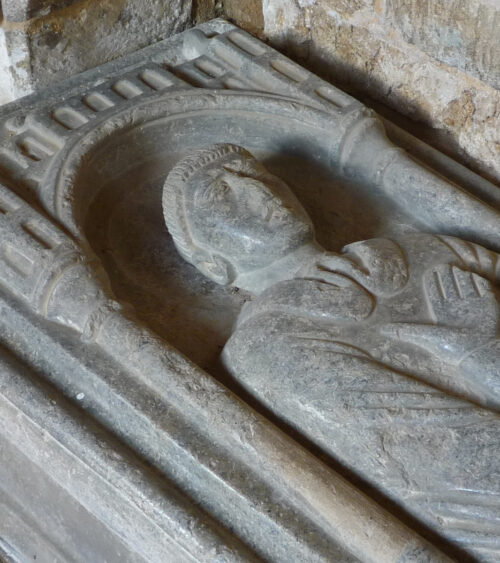
Roseia de
Verdun, foundress of Grace
Dieu Priory in 1240, from where the monument was moved at the
Dissolution. The tomb chest is later but the shafts and canopy
surrounding the effigy, which is similar in dress to the
Fontevraud effigies, are 13th century. Gray sandstone, much
recut, especially the face, but still a beautiful monument |
|
| Bottesford |
|

|

|

|

|

|
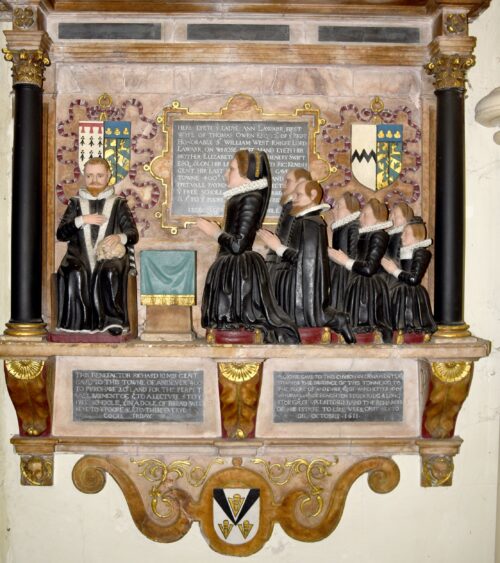
Inscription
plate to Robert de Roos (1285) & Wife
referring to a hear burial.
Minature, incomplete figure of
knight above is said to represent him. Purbeck marble.
|
Lady in wimple,
c 1310 - 20, ironstone. |
William, Lord Roos (1414),
alabaster knight on a tomb chest with angels. |
John, Lord Ross (1421),
similar to left. |
Detail from monument of 6th Earl |
|
Henry de Codynton,
Rector (1404), brass. Figure with tall canopy.
John Freeman, Rector in
1420, small & now headless.
1st Earl of Rutland (1543)
& Wife. Alabaster with two recumbent effigies
on tomb chest with weepers. Inscription. Gothic with
early Renaissance detail. By Richard Parker of
Burton-onTrent; it cost £20.
2nd Earl of Rutland (1563)
& Wife. Alabaster table tomb, under which the
effigies and on top three smaller kneeling effigies,
facing the foot, between which upright slab with arms.
3rd Earl of Rutland (1582).
Alabaster; typical Elizabethan type with two recumbent
effigies on rolled up straw mats and back wall with
inscriptions; one small kneeling figure at foot. This -
and the monument to the 4th Earl - were by Gerard
Johnson in Southwark and shipped north, costing
£100 each.
4th Earl of Rutland (1588)
Alabaster; as above but with kneeling figures
at head & foot and six on ground at side.
5th Earl of Rutland (1612)
; Alabaster and similar to above but lower relief;
between columns at the side, figures of Labour & Rest.
By Nicholas Johnson and cost £150.
6th Earl of Rutland (1632)
Alabaster and the grandest. Effigies of the
Earl and his two wifes at different levels. Two kneeling
figures to the east and one to the west. The inscription
refers to children "killed by wicked practice and
sorcery."
7th Earl of Rutland.
(1641) by Grinling Gibbons, the effigy
being carved by Quellin. Baroque, standing
figure in Roman dress on pedestal.
8th Earl of Rutland (1679)
Marble by Grinling Gibbons, two standing
figures in Roman dress with urn between them.
Sir John Thoroton,
architect, (1820), plain tablet.
Most of the 18th century monuments
were moved to the Belvoir mausoleum.
|
|
|
| Edmondthorpe - St Michael |
Sir Roger Smith (1655), two wives,
son & grandson. Three effigies of the first
generation on rising tiers; demifigure portraits of the
others in niches. Large superstructure. Alabaster.
Sir Edward Smith (1707), alias Heriz,
hanging monument.
Dame Olivia Smith (1710), as above but
grander.
Peter Boundy (1710), Rector. An attempt
to make a double 13th century sedilia into a monument to
the Rector & his wife during lifetime of both and dates
of death ommited.
Edward Smith (1762) |
| Kirkby Mallory - All
Saints |
Incised slab of 1404 or earlier.
Sir William Noel, erected
1679.
Semi-reclining figure in armour.
Sir Clobery Noel (1733), hanging
monument with two heads in profile in medallions.
Captain Thomas Noel (1756), standing
monument with obelisk in relief and trophy in front.
Viscount Wentworth (1774), two urns
with tree between. |
| Leicester: All Saints
(Redundant) |
Mathew Simons (1714), bust under
canopy with standing putti outside two columns.
Mrs Forrester (1805), female figure
kneeling over a sarcophagus by
Whitelaw of London.
William Forrester (1843), female figure
kneeling over a pedestal with medallion in profile.
Several slate headstones in church yard . |
Nosely St Mary
(church in private hands) |
Many incised slabs from 1400 onwards.
Sir Thomas Hasilrige (1629) & Wife;
alabaster & pink Derbyshire marble big standing wall
monument. Two recumbent effigies on tomb chest with
shields and angel columns. Eight boys and six girls
kneel above.
Sir Arthur Hasilrige (1660) & Wives;
white & black marble, slate & alabaster. Two recumbent
effigies with second wife, in window's garb, behind.
Twelve children kneel below. On the back wall an oval
incription plate with black columns and semi-circular
pediment. Attributed to
William Wright.
This Sir Arthur was an active Parliamentarian during
the Great Rebellion and played a important part in the
later days of the Commonwealth.
Lady Hasilrige (1673), hanging monument
of black & white marble. Angles hold curtain,
inscription plate.
Sir Robert Hasilrige (1712),
hanging monument, fluted pillasters holding a pediment
on which cherubs.
Sir Arthur Hasilrige (1763), oval
tablet with Rococo swags, by William Cox of
Northampton. |
| Prestwold - St Andrew |
Late 15th century alabaster tomb
chest with incised slab and seated with bedesmen and
angles holding shields.
Two ladies (1520), alabaster with
seated bedesmen around tomb chest; canopy gone.
Sir William Skipworth & Wife (1631),
recumbent effigies.
Sir Christopher Packe (1682), standing
wall monument with semi reclining figure.
Mrs Francis Andrew (1800) two standing
female figures in draped mantles below an urn. By
Bacon Jnr.
Major R Packe (1815), with relief of
battle scene. By J C F Rossi.
Charles James Packe (1839)
with
truncated column; by Westmacott Jnr.
Charles Hussey Packe (1842), Gothic
tomb chest with recumbent figure of youth in Eton
clothes; by Westmacott Jnr.
Marianne P C Packe (1922), bust but
this was carved in 1844 (by Westmacott Jnr) and
taken from the house as a memorial.
Lt-Col G H Packe (1912), Big standing
angle in relief, kneeling and holding up model of the
church; also portrait medallion. By Morris-Harding.
Edward Henry Packe (1946), standing
terracotta angle by Arnold Machin. |
| Rothley - St Mary & St
John the Baptist |
Bartholomew Kyngston (1486) & Wife:
tomb chest with incised lid. The inscription is his
will.
Robert Vaughan (1530) & Wives, incised
slab.
Humphrey Babington (1549) & Wife, tomb
chest with incised lid. Against chest rebus of baboons
holding shields atanding on a tun.
Thomas Babington (1567)
& family,
hanging monument with many small figures.
Anne Babington (1648), oval niche with
demi-figures of husbsnd and wife holding hands.
Attibuted to Edward Marshall.
A panel from an Elizabethan monument of two mermaids
holding shield with Kyngston arms impaling Sheffington.
In churchyard: headstone to
William Hunt (1794)
with relief showing collapse of the church on
the Day of Judgement. By
Hind of Swithland. |
|
| Fenny Drayton - St
Michael |
Edward Purefoy (1545) & Wife.
Incised slab on tomb chest with Early Renaissance
decoration and weepers.
George Purefoy (1593) & Edward (1594),
erected in 1596. Two big arches on attached columns.
George Purefoy (1628) & Wives.Six
poster with recumbent effigy on tomb chest surrounded by
kneeling children. Above against wall larger kneeling
figures of his two wives both facing east |
| Leicester: Cathedral -
Church of St Martin |
Two
civilians, incised slab of
Tournai marble, once inlaid.
Ancaster stone slab (15th century),
four times reused.
John Whatton (1656) & two Wives, busts
in niches by Joshua Marshall.
George Newton (1746), three free
standing busts on big pedestal.
John Johnson (1814), architect, Rococo
standing figure of Hope with anchor, designed by the
commemorated and carved by
J Bacon.
Rev E T Vaughan (1829), standing
figure, Grecian.
King Richard lll (k. 1485), slab
erected in 1980, by David Kindersley. The King
was buried in Grayfriar's Church in the city following
his death at the Battle of Bosworth. His tomb was said
to be of alabaster. Both tomb and church destroyed at
the Dissolution. |
| Lutterworth |
Early
15th century alabaster tomb
chest with knight/ lady
effigies;
angels with shields against tomb chest. Under arch at
the apex of which is an angel holding a soul in a
napkin.
John Fielding (1403) & Wife (1418),
brasses.
Civilian & wife, brasses
Many slate headstones in church yard. |
| Old Dalby - St John
the Baptist |
Sir Andrew Noel (1562) & two wives,
recumbent effigies on tomb chest against which mourners.
Wife & two husbands (1580), similar
tomb chest to above but short, kneeling children at one
end.
Andrew Noel (1603) & Wife, recumbent
effigies, he on half rolled up mattress. |
| Quorndon - St Bartholomew |
Several incised slabs from 1501 - 1561.
Thomas Farnham (1574)
& family, hanging
monument with many kneeling figures.
John Farnham (1587) & Wife, effigies on
ornamental tomb chest, battle relief against wall.
Inscription. By Epiphanius Evesham.
John Farnham, erected
1817,
two standing mourning women by urn. Background is a arch
with open door.
Edward Farnham (1835), Italian Gothic
style with twisted colonettes and canopies.
Edward Basil Farnham (1879) - the same
as above |
| Scraptoft - All Saints |
A Priest, much defaced.
Sir Edward Wigley (1710) & Wife, two busts against
background with two shallow arches.
James Wigley (1765), hanging monument with
sarcophagus on which relief of the commemorated
supervising tree planting and seated figure of
Brittania.
Tablet by William
Firmadge of Leicester to his wife and
three children (1793): Charity as a mother with children |
|
| Shepshed - St Botolph |
Thomas Dupont (1592) & family, brass
plate.
Ambrose Phillipps (1696), Baroque
cartouse with cherubs and urn.
Sir Ambrose Phillipps (1706), Baroque
wall tablet with cheuibs heads, volutes and crowning
urn.
Elizabeth Phillips (1709), Doric
pillasters, lamps (not urns), hourglass & cherubs below.
Sir William Phillips (1729), similar
to Sir Ambrose's but with cherubs and no urn. By
Robert Taylor the Elder.
Ambrose Phillips (1737), the largest:
aedicule surrounded by two Corinthian columns supporting
an open pediment. In the tympanum books and writing
material and inscription in Latin, a tributed to the
commemorated's erudition and interest in classical
architecture. Black sarcophagus with big urn. Designed
by Robert Taylor, carved by
Beresford.
Charles Phillips (1754), inscribed
marble tablet
John Phillips (1756), inscribed marble
tablet.
Jane Phillips (1761), Neo-classical
wall monument: urn in relief with two female figures
against an obilisk
Samuel Phillips (1774), similar to
Jane's but half-round. By
Richard Haywood.
Lady Gordon (1796), widow of above,
neo-classical tablet.
Rev William Phillips (1818),
neo-classical tablet.
Mrs J H Hamilton (neé Phillips) (1830)
Neo-Greek tablet.
The tablets came from the mausoleum at Dishley, where
still lie the coffins, in 1845. |
|
| South Kilworth - St NIcholas |
 |
 |
| Effigy of a priest |
|
| Stapleford - St Mary
Magdalen |
Geoffrey Sherard (1490)
brass with
fourteen small standing figures of children.
1st Lord Sherard of Leitrim (1640) & Lady
Abigail, black & white marble. Two recumbent
effigies on tomb chest which has black columns at the
corner holding the black covering slab. Eight children
kneel at borders of the slab and there are three
recumbent infants.
Bennet Sherard, Lord Sherard of Leitrim (1699)
- bust
Philip Sherard, Earl of Harborough (1750)
- bust
Bennet Sherard, Earl of Harborough (1770)
- bust
Robert Sherard, Earl of Harbourogh (1799)
- bust.
These bust are arranged together.
1st Earl of Harborough (1732), half
seated, half reclining figure in Roman costume, at his
feet Lady Harborough and infant. Grey marble obelisk
with busts and arms behind. By
Rysbrack. |
| Tilton-on-the-Hill - St Peter |
Sir John Digby (1269) & Wife,
recumbent effigies, he cross legged
Sir Everard Digby (1509) Military
effigy on tomb chest with shields.
Nichols Family, 1638, hanging monument
with small kneeling figures.
Tomb chest
with shields (mid -
late 17th century) |
|
| Thurlaston - All Saints |
Hugh Turville (1340) & wife (?)
- civilian, cross legged and bearded & lady - sunk
relief bust and feet only showing.
Young male, 14th century.
John Turville (1509) & Wife, alabaster
effigies on tomb chest with angles holding shields.
At the foot of the above, the lower half of a
15th century incised slab with two figures.
Edward Turvyle (1629) & Wife, two bust
in oval niches.
Elizabeth Turvyll (1653), frontal
demi-figure, elbow resting on a skull, in an oval
within a aedicule. |
| Wistow - St Wistan |
Sir R Halford (1658), semi-reclining
effigy on elbow with at head and foot a kneeling child.
On the back wall pilasters, pediment and putti standing
outside.
Sir William Halford (1768), tall base
above which in relief an urn between two females.
Sir Henry (1839) - tablet with healer
at a sick bed; ; by R Westmacott Jnr. Sir Henry
was Royal Physician for George III, George IV, William
IV and Queen Victoria.
Lady Halford (1831) - a tablet with
praying female figure at base; by
R Westmacott Jnr
Sir John Vaughan (1839), a tablet with
a seated female figure holding a book marked Leges
Angliae at base; by R Westmacott Jnr |
|
|
|
|
Thanks to founder-member Sally Badham for the
photographs of Bottesford and to Jean McCreanor for the photographs in
South Kilworth
|
|
Return to previous ('Monuments') page click
here |