Monument of the Month

June 2013


'Left for dead'
Major Thomas Price


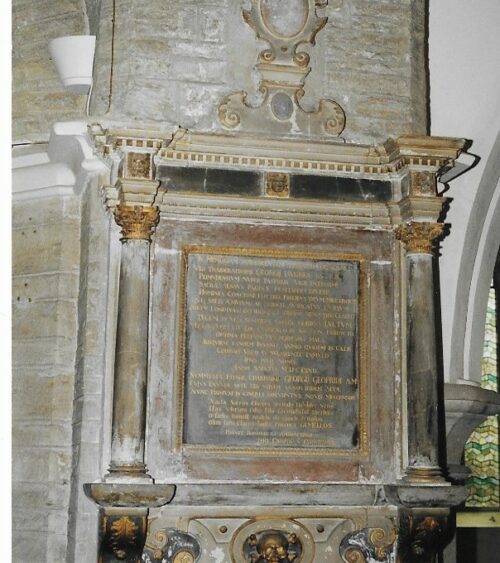
The Siege of Gloucester 1643 has been claimed to be a pivotal point in one of the most important events in English history: the English Civil War.  Gloucester sided with the Parliamentarians leading to the city being besieged by Royalist troops commanded by Charles I.  Today few reminders of this stirring event remain. There is however a large baroque monument to Major Thomas Price, a Royalist officer, the only monument on the north wall of the chancel of St John's church in the city.  It is believed that the monument is by one of the Reeves, the local long-established family of masons.
Major Price, who died in 1678, is shown as a demi-figure in the uniform of a Major of the Lancers at the time of the Civil War.  His left hand grasps the pommel of a sword while his right holds the short truncheon of a commander.   Above, two cherubs lean on skulls while holding laurel wreaths of victory symbolising eternal life.  Between them a cartouche contains a coat of arms of Price impaling Driver.  He married Dorothy, the widow of Robert Windowe of  Avening and daughter of John Driver of Ashton-in-Avening, who out-lived him, eventually dying in 1722 aged 94.  It has been erroneously recorded that there are also two inverted torches.  These are in fact cornucopia, the usual symbol of a full and bountiful life.  And what a life he had.
The Latin inscription on the monument, along with a recorded inscription on a lost ledger stone,  describe Major Price as alderman, twice mayor, and Major of Horse to Charles I.  During the Civil War he was said to have been often wounded, and on one occasion left for dead.  From other sources it is known that prior to the Siege of Gloucester he was one of the stewards of the city and his name was recorded on the list of 104 citizens of Gloucester with Royalist leanings drawn up by Sir Edward Walker, Charles I's Secretary of  State.  On the outbreak of the Civil War he left Gloucester and fought for the King.  He eventually returned to the city and became prominent again in local affairs, serving both as mayor and sheriff.  His standing was such that he was granted the right to issue in his name a farthing token which could be used as currency within the city.  It is interesting to note that although he was mayor, sheriff and a successful business man he chose to portray himself on his monument as a Royalist officer in armour.
 Directly opposite the monument to Major Price, on the south wall of the chancel, is the monument to his daughter Dorothy (d. 1693), erected by a second daughter Bridget (d. 1753).  The marble monument shows Dorothy as though asleep while beside the bed weeps a second woman.  Could this be Bridget?  If so, Major Price has stood guard over his two daughters for over two hundred years.


The Siege of Gloucester lasted  26 days from10th August to 5th September 1643.  Accurate numbers of those killed are not available.  Royalists claimed to have lost 100 while the Parliamentary sources put the Royalist losses as high as 1500.  By contrast the city claimed to have lost only 50 although this is likely to be a low estimate.

Given the possible number of deaths it is surprising that there is only definitely identified monument to a casualty of the siege.  A table tomb in the graveyard of St Swithun's church at Hempsted just south of Gloucester records the death of John Freeman.  The Latin inscription states that he died, aged 23, on the 14th August just five days into the siege.  It continues,  “Here lieth John Freeman, Captain of horse.........pierced through by the stroke of a gunner's bullet at the siege of Gloucester, in the camp of the King”.  There is no comparable monument to any of the townsfolk who were killed during the siege.
Indeed only one monument is known to a member of the Town of Gloucester Regiment who fought in the siege and lived to tell the tale.   This is to Thomas Pury the younger (d. 1693) who was a captain in the regiment and became an MP for the Monmouth Boroughs during the Commonwealth.  Appropriately for a parliamentarian he is buried in the churchyard of the 'Puritan' church of St Lawrence at Taynton.   The original Norman church was destroyed during the Siege of Gloucester and the present church built in 1647-8 by an act of parliament during the Commonwealth.  It is a very rare example of a church built at this time and it is oriented in the puritan fashion, north-south.
The most lasting effect of the Siege of Gloucester is however what cannot be seen.  On gaining the throne Charles II ordered in 1662 that the walls of Gloucester should be razed so that the city could never again defy the Monarchy.  This began the destruction of the walls, and today all that remains above ground is a 4 metre long section.
 
Robert Tucker  
        Monument of the Month - Contributions Wanted!
This page is designed for the general reader and is intended to feature monuments of all types and all ages: those to the famous and to the unknown, those by famous sculptors and those by unknown local craftsmen, the artistically spendid and the simple but beautiful or curious. So far mostly members of the Council have contributed but contibutions are welcome from everybody - members or non-members of the Society. We would welcome a photograph or two and a short text telling us why the monument interests you: it may be of an ancestor, of someone you admire, something you have discovered or just something you just like or find interesting. Please send contributions to churchmonuments@aol.com . We will feature the monument for a month and it will then be archived.

Some tips on the photographs:
1. It is always polite to ask the vicar or rector of the church for permission to take photographs, stressing they are not for profit or commercial purpose. It is important to confirm when the church is normally open. Don't forget to enclose a stamped addressed envelope for your reply.
2. Cathedrals and some other large churches have a visitors' desk and permission may often be obtained there on the day; sometimes there is a modest cost. Some of these churches do not normally allow photography although permission may be obtained if one writes before hand. To date the only place that I have been refused  is Durham Cathedral. Westminster Abbey and St Paul's Cathedral also do not allow photography.
3. Try to carefully remove items that block the view of the monument if you are able. Especially don't leave your camera case in the way as I have on occasion! Or alter the angle of the photograph to minimise this problem.
4. Try to avoid excessive contrast in taking the photographs - dark shadows and bright sunlight. In other words, try to see what the camera sees, not your eyes! Flash can be difficult to use as it creates harsh shadows and burned out highlights; this is especially difficult when a photograph is taken of a subject of some depth when the foreground becomes too bright and the background too dark, because of the rapid falling off of the brightness of the flash with distance.
5. Please send photographs as jpg or gif attachments; do not embed them in the text where they cannot be edited and require a lot of memory space. If you wish I can scan printed photographs if they are sent to me; they will always be returned.
Click on the link below to see earlier Monuments of the Month
January 2010 Thomas Moore (d. 1586) & his widow Marie at Adderbury (Oxfordshire) Sally Badham FSA
February 2010 The so-called ‘Stanley boy’ monument at Elford (Staffordshire) Dr Sophie Oosterwijk  FSA
March 2010 William Shakespeare’s monument, HolyTrinity, Stratford upon Avon, Warwickshire Dr Adam White PhD
April 2010 The Lovell Tomb at Minster Lovell, Oxfordshire Dr Ellie Pridgeon PhD
May 2010 The chantry of Humphrey Duke of Gloucester 1391-1447 at the Cathedral and Abbey Church of St Alban Jane Kelsall
June 2010 Thomas Babington of Dethick (d. 1518) and his wife Edith at Ashover (Derbyshire) Dr Kelcey Wilson-Lee PhD
July 2010 Baptist Noel, Third Viscount Campden (c. 1612-1683) at Exton, Rutland C B Newham
August 2010 Isabelle of Angoulême at Fontevraud Abbey J K Bromilow MInstP
September 2010 The Monument to Thomas Strode at Beaminster, Dorset Dr Clive J Easter PhD
October 2010 The cadaver monument of Guillaume de Harcigny (d. 1393) at  Laon (France) Dr Sophie Oosterwijk FSA
November 2010 The John Donne Monument (d. 1631) by Nicholas Stone in St Paul's Cathedral, London Dr Philip Cottrell
December 2010 Walter Helyon (d. c. 1357) at Much Marcle (Herefordshire) Sally Badham FSA
January 2011 Hungerford, Berkshire Dr Ellie Pridgeon PhD
February 2011 The Schaw Monument Dumfermline Abbey Church Dr Jenny Alexander
March 2011 Two wooden Epitaphien from Königsberg Jerome Bertram
April 2011  Abbot Adam of Carmarthen, Neath Abbey South Wales Dr Rhianydd Biebrach Ph D
May 2011 Sir John Newdigate, 1610, Harefield, Middlesex Jon Bayliss
June 2011  The joint tomb of João I of Portugal (d.1433) and his queen, Philippa of Lancaster (d. 1415) Founder’s Chapel, monastery of Our Lady of Victory, in Batalha, Portugal  Joana Ramôa
Photographs by  José Custódio Vieira da Silva
July 2011 Today and not tomorrow’ Doctor James Vaulx and his two wives Editha and Philip   St Mary’s Church, Meysey Hampton Joan and Robert Tucker
August 2011 The Bourchier Monuments in St Andrew’s Church, Halstead (Essex) Mark Duffy
September 2011 Two Monuments in Bedfordshire Cameron Newham
October 2011 Floor slab of Joost Corneliszoon van Lodensteyn, burgomaster of Delft (d. 31 April 1660), his wife Maria van Voorburch, and their descendants, Oude Kerk (Old Church), Delft (Netherlands), Belgian hardstone, 223 x 136 cm. Dr Sophie Oosterwijk  FSA
November 2011  Berengaria of Nevarre, Queen of Richard the Lionheart in L'Épau Abbey J K Bromilow MInstP
December 2011  The Watton Monument at Addington, Kent Dr Clive Easter
January 2012  The monument of Lady Margaret  Grey (d. 1330) at Cogges  Oxfordshire Sally Badham
February 2012 The Effigy of Walter Stewart, Earl of Menteith, at Inchmaholme Priory, Scotland Mark Downing FSA
March 2012  Thomas Walwyn (d. 1415) and his Wife  at Much Marcle (Herefordshire)   Sally Badham 
April 2012  Lady Barbara de Mauley, St Nicholas, Hatherop   Joan and Robert Tucker  
May 2012 The tomb of John Marshall in Llandaff Cathedral Dr Madeleine Gray PhD FRHistS
June 2012 The double tomb monument to Reinoud III van Brederode (d. 1556) and Philippote van der Marck (d. 1537) in Vianen (Netherlands) Trudi Brink
July 2012 Lowsley Family Tomb, Hampstead
Norris, Berkshire
Dr Andrew Sargent
August 2012 Oliver Cromwell's Coffin Plate J K Bromilow MInstP
September 2012 A Monument in Holy Trinity Church Hull Sally Badham FSA
October 2012 East Worldham (Hampshire) Sally Badham FSA
November 2012 Floor slab of Cornelis Pietersze (d. 1532) and his wife Jozijne van Domburch (d. 1557), Sint-Maartenskerk, Sint Maartensdijk (province of Zeeland, Netherlands), Belgian hardstone, 254 x 141 cm. Dr Sophie Oosterwijk  FSA and Kees Knulst BA
December 2012 An exercise in white marble and whitewashing: Cenotaph of Lieutenant-Admiral Jacob van Wassenaer Obdam (d. 13 June 1665), by Bartholomeus Eggers, situated in the choir of the Jacobskerk, The Hague (Netherlands), white, red and black marble and wood. Dr Sophie Oosterwijk  FSA
January 2013 Martin Kistenmaker and his Parents
Heiligenkreuz, Rostock
Jerome Bertram
February 2013 The monument to Archbishop James Sharp (d.1679) in Holy Trinity Church, St Andrews (Fife) Phoebe Armstrong
March 2013 The Monument at Sheriff Hutton (Yorkshire).
Is this the tomb of Richard III’s son?
Dr Jane Crease
April 2013 Zacharias Johannes Szolc, 1682, and Stanisław Bużenski, 1697 Frombork Cathedral, Poland Jerome Bertram
May 2013 The monument to Dr Thomas Turner, died 1714. Stowe-Nine-Churches, Northamptonshire  Dr Clive J Easter FSA  


¹