|

|
Downside Abbey |

|
|
This is a working Benedictine community
which was re-established in England in 1795. The present
buildings were begun in 1872.
These are the modern monuments of the
abbots, all in a medieval style. Unfortunately I have been
unable to name many of them.
|
|

|
|
Above: Cardinal Gasquet
(1929) Designed by Sir Giles Gilbert Scott and
carved by E. Carter
|
Below: Abbot Ramsay (ob 1929) by Scott
|
|
|

Above: Abbot Ford
|

|

|
| |

|
Top of Page |
|

|
Dunster - St George |

|
| Church open during normal hours.
There is limited parking in the town; otherwise a
relatively expensive pay and display car park a five to
ten minute somewhat difficult walk to the church. |
|
| Nave |
South Transept |
Chancel |
|

|

|
|

|
|
|
|

|
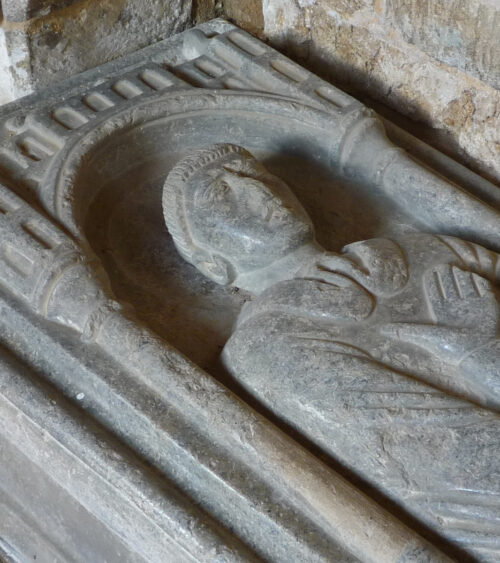
| Lady c 1300 |
|

|
|

|
|
Sir Hugh Luttrell (1428) &
Wife Alabaster. The Luttrells came into
possession of the castle in 1376
|
|
|
John Wyther
(1487) & Wife
(brasses on floor at
western most part of south aisle of the nave)
|
Adam de Cheddar (c 1350)
coffin lid with incised foliated cross. Not in situ.
|
|
South Chapel |
|

|

|
|
Lady Elizabeth Luttrell (1493)
Incised alabaster slab.
|
|

|
|
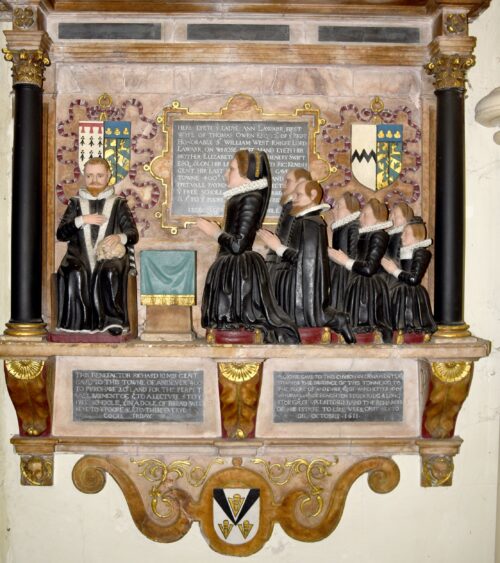
Thomas Luttrell
(1571) & Wife and
George Luttrell (1629) & Wife
(1613)
This monument was set up by George (the
kneeling figure) after the death of his wife
|
Mrs Ann
Luttrell (1731)
By M Sidnell of Bristol (signed)
|
|
|
|
|
|
|
|
Left: close ups of
figures from the 17th century Lutterell monument; and
Above: Close ups of
effigies from the 14th century Luttrell monuments
|
|
|
|
|

|

|

|
|
Sir Walter Hungerford IV
(1596)
Chancel: this and the tomb chest on the
right are similar but not identical
|
Mary Shaa (1613)
The slab is plain: she kneels with her
family at the front. Sister of Sir Walter IV & Sir Edward II
|
Sir Edward
Hungerford II (1607)
Chapel . Both of these two monuments have
deeply incised inscriptions on the top slab
|
|

|

|

|
|
Above & to left & right
Sir Edward Hungerford III & (1648)
& Margaret (1672)
Parlimentary commander in the Civil War
|
|

|

|

|
|
Above & to the left & right
Sir Thomas Hungerford (1398) &
Joan
He was the founder of the castle
|
|

|

|
Curiosity: Lead Coffins in the
Crypt (left)
Lead coffins were in use from about
1500-1650, some of which were anthropomorphic in shape. They
were originally contained in an outer wooden cases. Some of
these coffins have the face of the deceased moulded onto them;
sometimes this moulding may be actually taken from a death mask
but it is unlikely that this was the case at Farleigh
Hungerford.
There are eight such coffins at Farleigh
Hungerford: four adult males, two adult females and two
children. Four of these have faces moulded on them. The coffins
contain the remains of the following:
Sir Edward III & Margaret (Hallyday)
Jane Hele (1664), wife of Sir Edward IV
Edward (1689), their son
Alathea, his wife
|
|
Incised slab to a
chantry priest c 1500
Very worn but the head and shouldes can
just be made out
|
|

|
Farleigh Hungerford
St Leonard - Parish Church |
|
I made an unplanned visit to the parish
church of Farleigh Hungerford when I visited the castle.
Unfortunately it was firmly locked and there was no indication
on the notice board on the entrance to the church yard (there
was none on the actual church) from whom to obtain the key.
The monuments are:
1. Dorothea Torriano Houlton
(1799) & John Houlton (1839) 2. Mrs Shirley (1828) & 3. Lady
Wilson (1864)
|
| Glastonbury -
The Abbey |
|
The Anglo-Saxon Chronicle states (1016)
'King Edmund [Ironside] passed away and is buried with his
grandfather Edgar in Glastonbury'. Florence of Worcester states
(946) 'Eadmund [Edmund I] ... was killed...his body was carried
to Glastonbury and buried...'. (975) '...King Eadgar [Edgar] ...
departed this life on Thursday ... . His body was carried to
Glastonbury and buried there... ' (1016) ' King Eadmund
Ironside died at London and was buried at Glastonbury by the
side of his grandfather, King Eadgar'. However see the
Winchester page for the burial
place of Edmund Ironside. William of Malmesbury states 'By
common consent, then, it was determined that his [i.e. Edmund
I] body should be brought to Glastonbury, and there
magnificently buried, in northern part of the tower'. 'he
[Edgar] ... was buried at Glastonbury.' ' 1052 ... his royal
remains were placed above the altar in a shrine'. 'he [Edmund
Ironside] was buried at Glastonbury near his grandfather Edgar'.
(History of the Kings before the Norman Conquest) He reinforces
this is his Antiquities of Glastonbury by stating (although
somewhat ambiguously) that Edmund I was buried below the tower
to the right and Edmund Ironside was buried in front of the
altar. He further states that Edgar was at first buried in a
'pillar' before the entrance to the church but was later
translated to a shrine above the altar.
John Leland in his Itinerary, describing
his journey in the time of Henry VIII, states that Edmund
'Senior's' tomb was in the north part of the presbytery and
Edmund Ironside's on its south side. He does not describe these
monuments nor detail any epitaph. However he does give the
epitaph on the tomb of the legendary King Arthur which he states
is in the centre of the presbytery. King Arthur's body (or
rather a body reputed to be his) was exhumed from the cemetery
and reburied in the church in the time of Edward I. Leland
refers to Abbot Bere building the Edgar Chapel to the east of
the church; this was to house the tomb of the highly regarded
King Edgar in a most important position.
None of these monuments remains. It is
interesting to note that the site of Arthur's tomb has been
marked in modern times but those of the early English kings who
actually existed have not!
|
| Top of Page |
|

|
Goathurst - St Edward |

|
| Church open normal hours. Park in
the village; the church is at the end of the village |
|
|

|
Nave |

|
|

|
|
Sir
Charles Kemys Tynte MP (1785)
Younger brother of Sir John
By Nollekens
|
Milborne
Kemeys Tynte Esq (1845)
Lt 47 Royal Irish Reg of Dragoon
of Guards
Died in riding accident
|
Rev
Sir John Tynte (1742)
Rector 1731-1740
By J M Rysbrack
|
|
|

|
Halswell (North)
Chapel |
 |
|

|

|

|
|
Sir Nicholas (1633) & Bridget
(1627) Halswell
|

|
6 sons and 3
daughters
kneel around the t.c. He was MP
for Bridgewater and JP. He imprisoned in 1603 'one John
Gilbert, alias Gogulmere, a fanatical minister, for
having...attempted to preach naked in...North Petherton'
|
Isabella Anne Kemeys
Tynte (1835)
She died aged 3
Marble by Raffaeli Monti
|
Sir Hugh Halswell Tynte
& Other Members of His Family (1650)
Latin inscription. Note the
allegorical flanking figures of Faith & Hope; above are
two cheubs, one with hour glass, the other with skull.
|
|
Jane Halswell (d. 1646), grandaughter
of Sir Nicholas (above) was the sole heiress and she
married a John Tynte, uniting the two manors: their son
was Sir Hugh (above)
|
|
|
|
|
|
|
|
|
|
|
|
|
|
|
John (1668) & Margaret Shutt
|
Top: Samuel Day
(1806)
Bottom: Sarah [Banicer]
(1770)
|
Top: not legible
Bottom: George Clerke
Symonds (18[36])
|
Samuel Skurray Day
(1816)
|
Top: Walter Robinson
(1737)
Bottom: Robert
Painter (17[56])
|
John Painter (1809) by W
Brewer
|
|
|
|

|
Chancel |

|

|
|

|

|
| |
Sir Anthony Poulett (1600) &
Wife (1601) & Children
|
|
|
|

(c. 1475)
Note the two belts
|
|

John Thudderle &
Wife (late 15th C.)
|
|
Nave |

Anne Poulett (1765)
|
|

|

|

|
|
Above Left:
Vice-Admiral Hon. George Poulett RN
(1854) & his wife Catherine
Sophia (1831) & their daughter
Augusta Margaret (1836 age 16), & their
sons: Captain George A., of HM
54th Reg (1850), Lt Henry Ashton
V. Native Infantry of Bengal (1842)
& John Powell (1829 in infancy)
Above Centre:
John, 4th Earl & Viscount, 8th Baron
Poulett (1819)
Above Left: Thomas
Beagey (1826)
|
|
|

Rebecca Poulett (1765)
|
|

|

|
South Aisle
|

|

|
 |

|
|
Emma Sophia (1876)
wife of William, 6th Earl Poulett
|
William H. 6th Earl Poulett
(1899)
|
Catharine Cole
(1822)
|
Abigail Bicknell
(1824)
She died aged 18
|
Not legible |
|
|

|
Poulet Aisle
This aisle cannot be
entered but the monuments are easily visible over the
locked barrier. |


|

|
|

|

|
|
Bridgett Poulett
(1747)
|
John, 1st Earl Poulett (1744)
By Rysbrack
|
I was unable to read the
inscription on this monument |
Top: George
Amias Fitzwarrine, 8th & Last Earl Poulett (1973)
Bottom: Vere Earl
Poulett (1819) by Sir R. Westmacott
|
John Vere M. Amias
Poulett (1857)
By E. J. Physick of London
|
|


|
Poulet Chapel
This chapel is
entered via the Poulet aisle above so cannot be entered;
nor are the monuments visible |

|

|
|

|

|
|
Sir Amyas Poulett II
(1588) alabaster effigy; the inscription on the
tomb chest is in French. He was for a time guardian of
Mary, Queen of Scots, who described him as 'one of the
most zealous and pitiless men I have ever known'.
Brought here from St
Martin-in-the-Fields, London
see also photograph on the
right
|
Left Sir Amyas
Poulett (1537) & Second Wife & Right
his son Sir Hugh Poulett (1572) & First Wife
(above and below)
An identical pair; the t.c's are
reused older pieces. Note the kneeling
children. Probably organised by Sir Hugh on the death of
his father, the date of Sir Hugh's death being left
blank.
|
John
Baron Poulett (1649) Plaster. The putti over
the arms hold a circlet of flowers. The date looks early
18th century & by foreign craftsman.
|
Bernard
Hutchins (1733)
Black sarcophagus between twin
pilasters below a pediment. Below this is the whole of
the Sir Amyas II monument.
|
|
|
|
Top of Page
|
|

|
Keynsham
St John the Baptist |

|

|
|

|
|
Sir Henry Bridges (1587)
|
Thomas Bridges (date not
legible)
|
Andrew Chocke (1653)
|
Sir Thomas Bridges (1666)
|
|

Margarita Simpson (1792)
|

Joan Flover
(no date)
|

James Whippie (1787) &
Family to 1819
|

Edward Lynee (1819) by
King of Bath
|

James Bouchier (1753)
|

George Bridges (1677)
|

Incised slabs with insciptions and crosses
|
|

John Francis Cunning
(date not legible)
|
Langridge - St Mary
Magdelen
|

Ann Cunning (1817)
|

Lady early 14th century
The brass to Elizabeth Walsche (1441),
reported in Pevsner has since been stolen (information 2009)
|
|

|
Nettlecombe - St Mary |

|
|
The church open during normal
hours - park near the church
There is no village as such: 77
dwellings in the parish, Nettlecombe Court, the manor
house, and immediately next to it the parish church.
Nettlecome Court is now a Field Centre.
|
|
| South - or Ralegh Aisle |
Nave |
|

|

|

John Oatway (1798)
by King of Bath
|
|

|

|
|
Sir John de
Ralegh & Maud (c 1350-60)
A large hound - attached to the lady's
effigy - lies in between the two figures
|
A Raleigh (c. 1300)
Note heraldry (a bend fusilée) carved on
shield
|

Joan Alys Wolseley (1943)
with bronze Madonna & Child
by Ernist Gillick 1945
|
|
The above effigies lies in very deep tomb
recesses in the north wall; these extend out of the main body of
the church.
|
|

|
Right: Inscription
around edge reads:'Here lies the body of John
Trevelyan Esq. who was buried in the year of
our God 1623. His age was 67 years' The
face bears the arms and an inscription to his wife
Urith (1591) and says they left five
sons: John, George, Ames, Christopher & Elcana.
Left: Urith, Lady
Trevelyan (1697) the first wife of Sir John
Trevelyan (1670-1755)
|

There were also five daughters:
Elizabeth, Eulalia, Marie, Johane & Susanna.
|
|
An easy church to miss, so best to
obtain a 1:50 000 map of the area. Take the B3188 from
Elworthy to Monksilver. Nettlecombe is signposted on the
other side of Monksilver down an unclassified road on
the left. There is a left hand bend and then a hill to
climb. Don't go too far! Watch out for the cemetery on
the right, then immediately turn right along what looks
like a private road signposted to a Field Centre; this
is a large sign but below this is a small sign - easily
missed - to the church. Mind the steps down from the
south door entrance!
|
|
|

Ward
Family (1770) by
Ford
|
|
Lt
Col Alexander (1835) & Catherine Lawrence (1846)
Their sons included a
Brig Gen, a Mjr Gen, two Lt Gens, a Viceroy of India and
two baronettes; the daughter married the Rector |

John (1774) & Elizabeth Ash (1769) |
Top of Page |
|