|
In 1815 Stothard was employed by Daniel Lysons to make
drawings for the
topographical work
Magna Britannia;
this was a series of profusely illustrated county volumes
which, in fact, were
never to be
completed. To this effect Stothard journeyed through
Northern England and, in his absence, Lysons
procured him the appointment of historical draftsman
to the Society of Antiquaries. In 1816 he was
commissioned by the Society to journey to France to
make drawings of the Bayeux Tapestry and during his
stay visited the abbey of Fontevraud, then a prison,
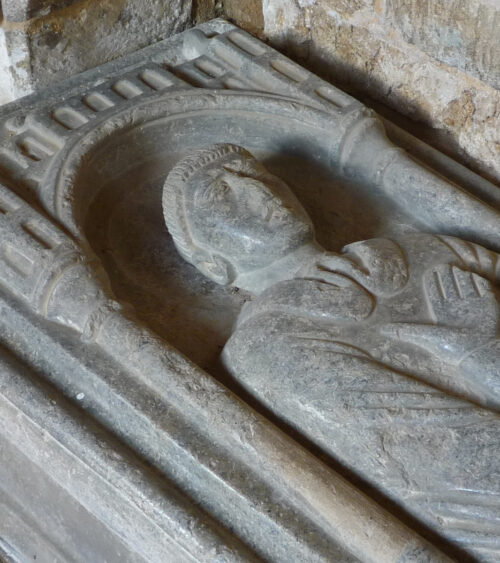
where he discovered the four Plantagenet effigy in a
'cellar' which probably refers to the well known
medieval kitchen. |
 |
In
1818 Stothard married Anna Eliza Kemp (1790-1883)
and they journeyed together in France. She later
became a writer and her first work consisted of
Letters written during a Tour of Normandy, Brittany
etc, describing this journey.
In 1821 Stothard
received a commission from Daniel Lysons to prepare
some drawings for the Devonshire volume of his work.
His wife was pregnant with their first child so he
travelled from London to Devon alone, carrying in
his pocket a note from her - Notes for the
observance of my beloved husband during his journey
- among which one read: Take care not to fall
from high places. |
|

|
He spent the following day, Saturday, travelling
and on Sunday afternoon reached Bere Ferrers, where
he was to make drawings of the medieval stained
glass in the east window of the chancel of St
Andrew's, the parish church. The rector, Revd Henry
Hobart, was in the church yard when Stothard arrived
and not only gave him permission to work in the
church but invited him to stay at the rectory until
the work was completed. Stothard walked over to the
church on Monday morning after breakfast to begin
work. Mr Hobart had borrowed a ladder from a local
gardener so that the artist could see the medieval
glass in the window more closely.
The Rector had arranged for his curate, Mr Servante,
to take Stothard to the church and to stay for a
short time to ensure the artist had everything he
required.
At 2.00 pm the Curate returned to find the work
half completed and the ladder still in its original
position at the south side of the altar, but
Stothard indicated that he would shortly move it to
the opposite side to complete the drawing. Dinner
had been arranged at the rectory at 5.00 pm and
about that time Mr Hobart was visited by a local
doctor; as the doctor left he asked him to look in
at the church to remind the artist of the dining
arrangement, probably thinking that the artist had
become so engrossed in his work that he had
overlooked this. The doctor found Stothard lying on
the floor near the altar, a rung from the still
upright ladder having broken; the artist had fallen
ten feet, striking his head on the base slab on
which a monumental effigy lies. The artist died
within three minutes of the doctor having found him.
|
|
|
Mr Hobart set about tracing the family of the dead
man. He found in his pocket an envelope with the
name of a London publisher, Thomas Cadell, to whom
he wrote detailing what had happened. Two days later
the publishers replied indicating that Thomas
Stothard, Charles' father, had that morning left
London for Plymouth. The gardener was a man of heavy
build and explained that he had used the ladder a
number of times immediately before he had lent it to
the Rector. The subsequent inquest was a mere
formality.
Charles Stothard was buried in the church yard at
Bere Ferrers on 4th June 1821,where his stone may
still be seen below the east window of the chancel .
As can be seen from the photograph, it now merely
rests on the ground, being fixed to the church wall
by two metal (aluminium?) clamps, which recently
replaced the earlier badly corroding iron ones.
Examination shows that the lower part of the stone
was originally set into the ground. There are
several stones around the church walls in a similar
condition, all of which indicated that the stone is
probably not in situ. I have not discovered any
records which indicate where the burial might have
been. Unfortunately the soft limestone of the stone
has not weathered well and the inscription is now
very difficult to read and in places totally
obliterated. The slate stones on either side and of
a much earlier date are still in excellent
condition.
However Rogers writing in (or slightly before) 1877,
that is only fifty years after the burial,
describes the stone - and hence after such a
relatively short period possibly the actual grave -
as being in this same position and the inscription
even by then being so worn as being virtually
illegible. This could suggest that the exposure of
the base of the stone is due to lowering of the
ground level to create the now raised path east of
the stone rather than raising of the stone itself.
Fortunately a transcript of the inscription is
recorded in Monumental Effigies and is reproduced
below.
A small brass plate - illustrated right - is
set into the floor of the chancel where the artist
fell.
Anna Stothard gave birth to a daughter, Blanche, on
29th June 1821 so soon after the death of her
husband. Sadly Blanche died the following year on
2nd February 1822.
|

| The chancel of Bere Ferrers Church.
Charles Stothard would have set his ladder
on the left side of the window. The monument
on which he struck his head can be seen to
the left. The brass plaque is on the floor
below the flowers |

|
|
 |
Sacred to the memory, dear to every friend who knew
him, of Charles Alfred Stothard, Historical Draughtsman
and Fellow of the Society of Antiquaries, eldest
surviving son of Thomas Stothard RA. While pursuing his
professional researches in the adjoining church, he was
unfortunately killed by a fall, on the 28th May in the
year of our Lord 1821, in the 34th year of his age. As a
laborious investigator of the ancient sepulchral
monuments and other historical vestiges of the kingdom
which he illustrated by his faithful and elegant pencil,
he was pre-eminent. As a man, though gifted with the
most solid abilities, he was humble, modest,
unostentatious, as example of benevolence and simplicity
of heart, a Christian by faith, as he proved by that
essential demonstration, his works. Awfully bereft of
such a partner, what words shall describe the deep, the
bitter sorrow of his widow, who stood not by to pay him
the last sad offices, but while he perished thus
untimely, expected his return, and shortly bless with a
first child. She had erected this poor monument to his
memory, a living one exists in her heart. Reader profit
by this sad (but doubtless in the wisdom of God)
salutary and merciful lesson for it is better that the
virtuous should be thus suddenly cut off than the
wicked! 'Watch ye therefore for ye know not when the
master of the house commeth, at evening or at midnight,
or at cock-crowing, or in the morning; least coming
suddenly he find you sleeping.' Mark XIII, v.35-36. |
|